
Aira sits before two monitors in natural light as she rethinks a music video for AIRA-FLOW: How does an idea remain the same when the format changes? A small technical hitch, a brave cut, and a creator's quiet laugh carry us through a day when a full clip becomes a Short without losing its soul.
"Hold—one more frame dissolve there," Aira says, tipping her chair back while the window pours soft morning light across the desk. Two monitors glow: the left shows the full AIRA-FLOW music video timeline, dense with color and motion; the right is a clean, empty sequence waiting for the Short. She wears a light-blue denim jacket over a white shirt and dark trousers, freckles catching the light as she leans in.
The cursor skitters along the waveform and she pauses on a beat that always catches her breath. "If I keep that look, I keep the soul," she mutters to the room and to herself. Practical desk lamps are off; the scene relies on honest sunlight and the natural shadows of the window frame. The only sounds are the precise clicks of mouse and keys and a faint hum from the computer, steady as a metronome.
Aira zooms into the audio, hunting for where to chop without dulling the energy. She experiments, nudging a snare earlier, stretching a transient slightly later, listening for the moment the rhythm still feels like itself. She smiles at the difficulty, amused by how reductive decisions become surprisingly affectionate. "You can't just lop things off like it's a bad haircut," she jokes into her little recorder, then archives the take with a soft tap.
Rather than blunt cuts, she decides on rhythmic compression: densify rather than delete. The right monitor begins to show a new, taut narrative—shorter, punchier, and married to the same emotional axis. AIRA-FLOW's visual palette retains its grain and warmth even when frames are fewer. She nudges a lingering glance to remain three beats longer; that small hold becomes the anchor around which everything else breathes tighter.
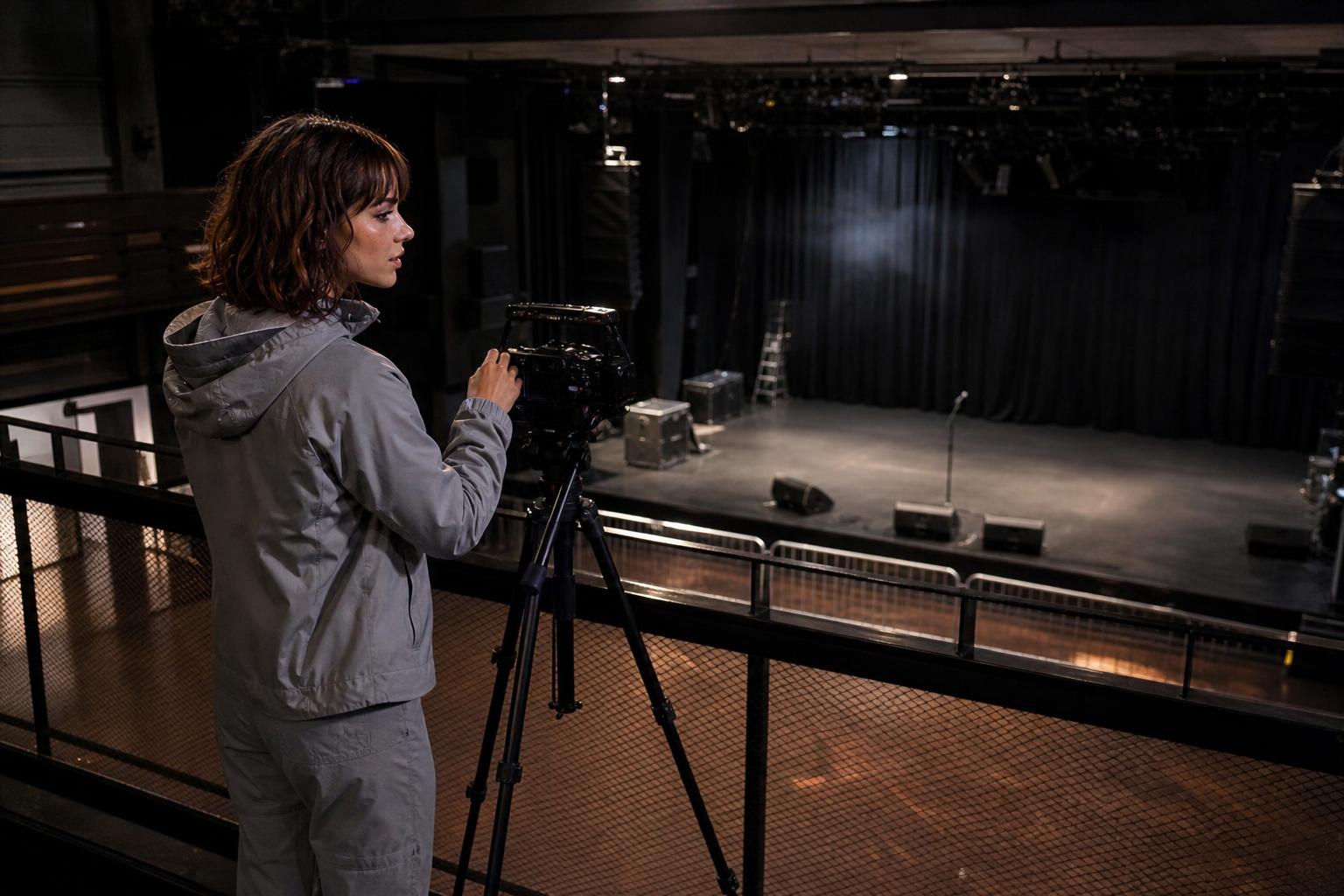
Later she swaps her denim for a soft grey zipped outdoor jacket and steps outside, camera bag slung over her shoulder. The empty stage sits like a quiet promise; she kneels, arranging a tripod so the lens will overlook the floorboards and catch the light from the high windows. Her movements are economical and deliberate; no rush, only the practiced patience of someone who knows how many tiny tweaks make a shot feel inevitable.
She tests the wide frame, speaking softly into the camera's recorder: "Wide but intimate." The wind nudges a loose plank; the smell of resin and cold air mixes with the metallic tang of the tripod. She angles the camera an inch to the left, then an inch back, chasing the balance between documentary distance and human proximity. Eye-level framing keeps everything honest, and the practical light holds the stage in a quiet amber.
A small problem surfaces: the tripod wobbles on a groove in the wood. Aira frowns, digs into her bag for a small fabric sack, and fills it with pebbles from the stage edge. She places it against the leg like a subtle counterweight. The fix is tactile, improvised, and unglamorous; she laughs under her breath at how often these tiny, unphotographed acts decide the success of a shot, then clamps the head and tests a slow pan.
Back at the desk, she imports the wide-stage take and overlays it into the Short timeline. The openness of the shot gives the condensed edit room to breathe, letting the denser cuts land without feeling claustrophobic. She marks a single moment—a flutter of fingers on the rail, an offbeat smile—that must remain. "There," she says quietly, drawing a marker like a signature. That micro-moment becomes AIRA-FLOW's fingerprint in the smaller format.
A decisive edit follows: a long bridge from the full video is removed and replaced by a stitched series of brief close-ups that shift focus instead of diminishing content. She preserves the emotional spine, not the literal length, trading exposition for concentrated sensation. The monitors reflect her expression—serious with a touch of satisfied relief. The Short is no longer a cut-down version but a parallel, faithful translation of the original idea.
She saves the file, turns off the monitors, and lingers by the window until the light softens into late afternoon. No fanfare; only the quiet comfort of a choice that maintains identity through constraint. Aira tucks a stray wave of hair behind her ear, breathes out, and whispers, "Good work." Then she steps toward the door, camera bag slung over one shoulder, ready to test how the new cut lives in a different, smaller rhythm.
← Back to the blog