
A fictional scene from the AIRA-FLOW world: Aira aligns camera and light so that image movement and musical energy become one. Two sets, two choices, a quiet compromise with weather and time — told in close, practical images.
"Not too fast—breathe the beat." Aira gives the camera a short, deliberate tug; the lens sits at eye level and the wet asphalt still shines. The unbranded sedan is parked crooked at the curb, headlights off, its lacquered hood reflecting a low, bruised sky. Her voice is dry but warm, and she counts beats with small gestures, as if the rhythm lived only in her hands.
She wears a navy long-sleeved shirt rolled at the cuffs and charcoal trousers, sleeves showing wrists that move like metronomes. Short, wavy brown hair catches the dusk in cool highlights; green-teal eyes scan edges where frame meets street. Subtle violet stage makeup adds a faint shimmer to her cheeks, just enough to catch the camera’s attention without calling attention to itself—AIRA-FLOW’s presence is in the way she frames a pause.
The tripod is modest, her right hand on the pan grip; she moves her torso, not merely the device. A puddle rims the curb and a light drizzle threatens to widen it. She frowns, shifts her feet, and decides to tighten the arc. "Tighter arcs, we skip the long glide," she murmurs, more to establish tone than to command, tracing a new axis with the toe of her shoe as if drawing invisible rails.
Practical lighting organizes the scene: a street lamp two meters up, a battery flood behind the car, and a pair of LED panels in the trunk. Aira works with them, angling a panel until its beam scratches a rough edge across the hood—precisely where a close-up will land against a mid-track interlude. The light isn’t beautiful so much as useful; it punctuates rhythm with reflective punctuation rather than spectacle.
An assistant calls from the sidewalk about a delivery van slowing nearby; a small human interruption threatens the cadence. Aira smiles, quick and wry: "Use brake lights as a fill. A little taillight staccato will do wonders." The decision is instant. The mundane timing of real traffic becomes a tiny accent, a found percussion that she folds into the visual vocabulary rather than erasing it.
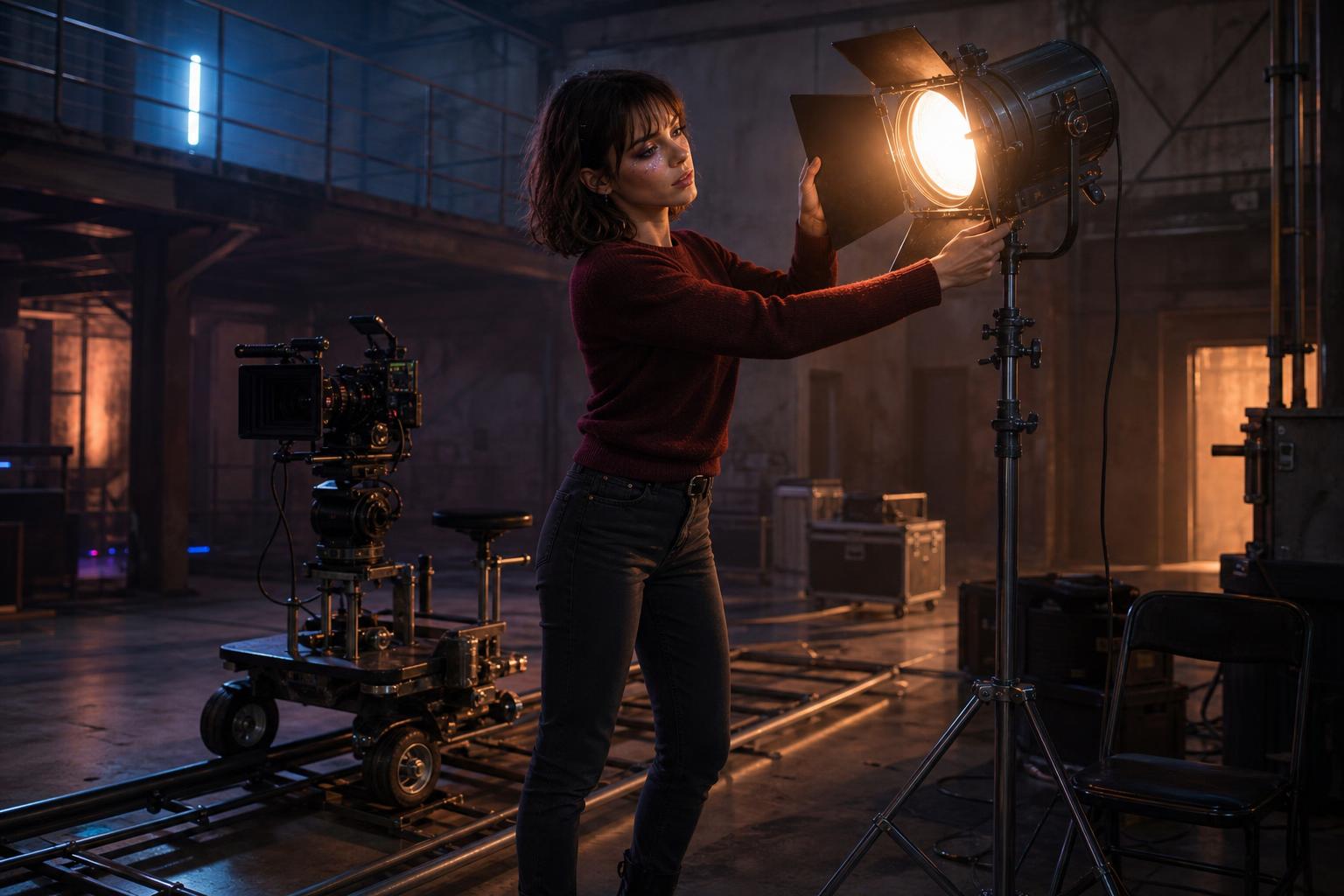
The cut is short and almost cinematic. The warehouse swallows sound differently; there, Aira has changed into a burgundy crew-neck sweater and dark jeans, same subtle violet makeup but a different silhouette. The camera lies low on a dolly, and the view is a side-on study of motion. Rows of tables, overhead lamps, and a practical workshop lamp become instruments in a new composition where shadow and flange matter more than flash.
She kneels beside the dolly to position the workshop lamp millimeter by millimeter, fingers mapping the lamp’s shade so its beam will graze the rail. The lamp throws a warm, angled wash that catches metal grains and dust motes; she speaks softly to the pull of light and motion: "We need the shadow to cut, not just fall." Her instruction is poetic in a precise way, an aesthetic choice disguised as a technical note.
A slack in a cable causes the dolly’s wheels to stutter by a fraction; the sound is a small, cruel hiccup in an otherwise rhythmic environment. Aira tugs a length of gaffer tape, smooths the cable across the floor, and tests the run again. When the dolly rolls true the second time, the side-on framing holds steady while highlights slide along the camera body like breaths syncing to a drum pattern.
She trims the lamp’s angle so the shadow of a steel beam strikes the floor with a hard edge, a percussive cut that she envisions as a sync point. "Cut on that shadow, then back to us," she says, laughing softly because the simplicity of it delights her. The warehouse seems to nod back; the light, the dolly, the small crew—each choice is a tiny stitch in AIRA-FLOW’s visual language, practical and human.
There is no grand finale—just the gear cooling and the room settling. Aira lifts the camera from the dolly, stretches her neck, and surveys the two sets like someone who has just finished translating a short poem. The lamps still glow, the wet street breathes in the evening, and the footage waits for sound to meet it. "Good for now," she says under her breath, a modest verdict that keeps options open for what the music will later demand.
← Back to the blog