
Aira crouches in warm daylight, violin tucked under her chin, coaxing its wooden voice into a dense electronic bed. A minor resonance forces a quick decision; the result stays delicate — an acoustic skin within a heavy EDM weave. A short, intimate fictional moment from the AIRA-FLOW world.
“Closer, like you’re whispering in her ear,” Aira says, lowering her jaw and letting the violin’s wood speak almost by touch. Sunlight pours through a south-facing window, warming the grain; a condenser mic sits at eye level, practical and intentional for the camera. The cream crew-neck knit edge brushes her jaw; she smiles softly and draws a clean line across the E string.
She pulls the bow back and listens to the room, catching a stubborn foggy resonance that threads between the plaster and the glass. A tiny curse slips out, equal parts surprise and amusement; she talks to the instrument like an old, contrary friend. Her dark blue jeans show the crease of long sitting, her fingers precise — each motion a compromise between muscle memory and the microphone’s honest ear.
The first take opens with a warm, intimate phrase that rubs against an imagined low-frequency pad. She stops after a few bars, lowers the violin and nods, not to anyone but to the space itself. There’s no tech jargon, only a glance toward the laptop where a visible waveform bobs; Aira decides to nudge the violin away from the window slightly, calming that unwanted ring with a pragmatic shift.
On the second run she plays harder, letting the bow sing and trying brief percussive articulations between sustained notes. The mic captures every wooden nuance without becoming brittle; the balancing act is preserving organic warmth while knowing the arrangement will thicken. She murmurs, “More air, less sheen,” a private incantation, and laughs at herself when a tiny squeak becomes part of the charm rather than a flaw to be erased.
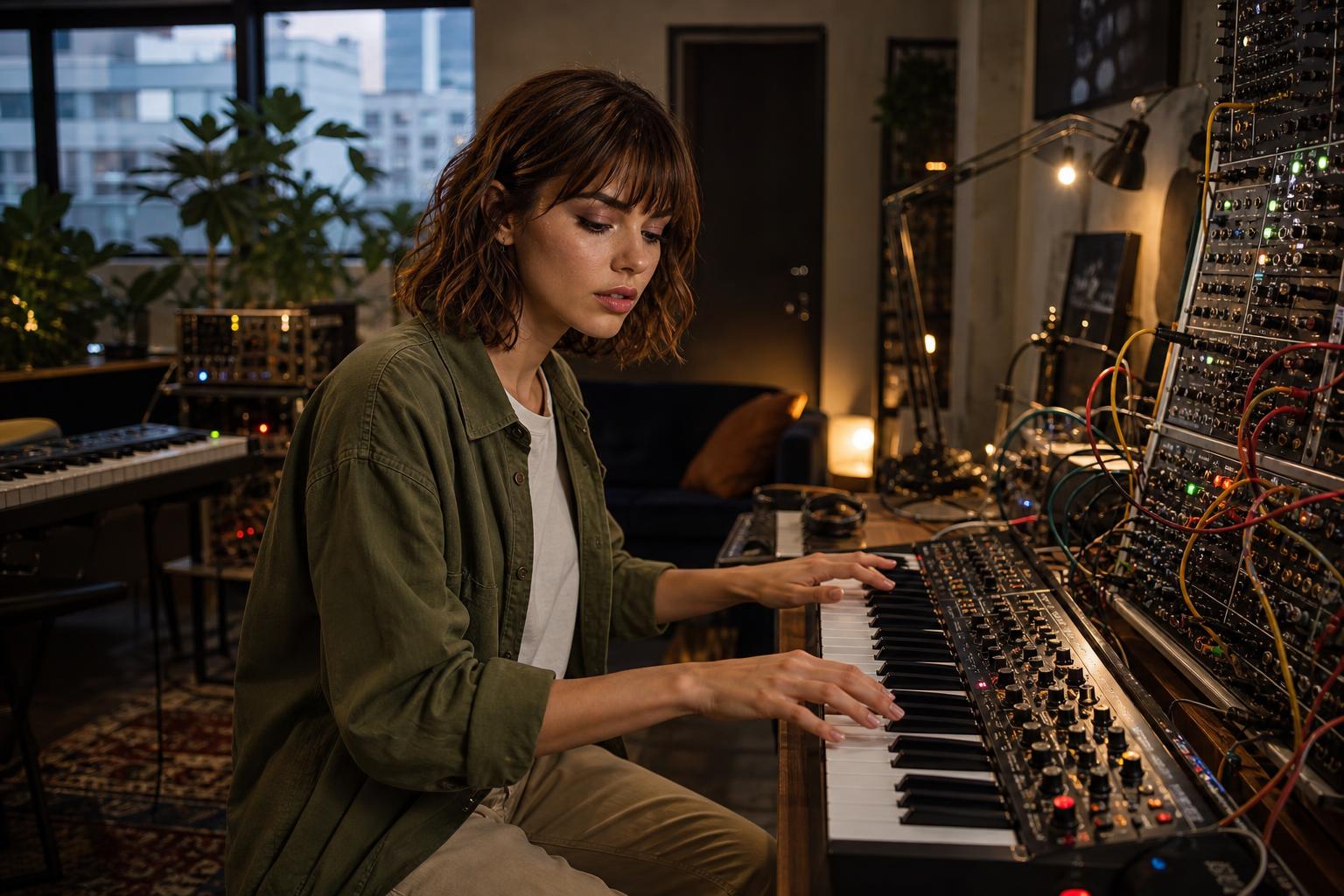
The wardrobe change is quietly practical: she eases the violin into its case, slips into an olive-green overshirt over a white crew-neck T-shirt and swaps the jeans for beige trousers. The light remains familiar, gentle and consistent, as the setting tightens into a smaller, modular corner. Cables lie like veins, patch cables coiling patiently; the camera stays eye-level, closing in on the spaces where face and hands meet instrument.
Seated at a compact keyboard beside a modular synth, she lays a simple chord progression under her fingers, small human imperfections blooming into rhythm. Close-up catches freckles near her nose, natural makeup, and the focused lift of an eyebrow when a filter on the patch shifts the timbre into something unexpectedly vocal. She grins, the sound surprising her; the patch answers like a conversation, all movement and texture.
A technical hiccup: a patch starts to hum and the VCO slips out of tune, a thin buzz creeping into the warm field she’s building. No panic, just a quick, considered frown and an adjustment—turn a filter, pull down resonance, let an LFO wobble instead of forcing a sterile lock. The choice is aesthetic, not just corrective: embrace the organic flutter to keep the acoustic violin clear against synthetic pressure.
Her hands move fluidly between keys and patch points, a finger leaving a soft delay tail that she contrasts with a single sub-bass thump. Low and close, she breathes halfto herself, “Don’t drown her, hold her hand.” The camera frames her eyes and the small choreography of fingers; AIRA-FLOW’s identity is audible in those decisions, where real textures and electronic density must learn to share space.
As they roll into a longer take she finds a sweet spot: the violin keeps presence as pads and kick gain sculptural weight around it. The fix was not an aggressive cut but arrangement choices—leave room, define frequencies, accentuate articulations. She scribbles a tiny diagram on a scrap of paper, stands to stretch, and lets sunlight lay across her shoulders for a moment, satisfied by the fragile equilibrium she’s built.
The session winds down without fanfare; she closes the case gently and breathes out, smiling. “That’s it — that’s how she stays real,” Aira says to no one in particular, pleased with the balance. Instruments hum in residual resonance, warm light softening the edges. In this small, fictional AIRA-FLOW workshop, the decision-making is intimate, the results unshowy: acoustic warmth and electronic pressure finally learning to breathe together.
← Back to the blog