
Aira sits beside a single wooden speaker in a sunlit room, testing the quiet: a short intro, deliberate gaps and an uncluttered sound make a drop arrive like a presence. A small mechanical nuisance forces a quick fix. Later, on an empty stage with one warm lamp, AIRA-FLOW breathes in the pauses and the drop is measured by what’s left unsaid.
“Hear this,” Aira says, tilting her head toward the single wooden speaker perched on a low stool, sunlight drawing a soft rectangle across the floor. She’s in a cream crew‑neck knit sweater and dark blue jeans; her fingers trace the speaker’s edge as if reading a map. The room is spare — a window, a stool, the speaker — and she listens for the space between sounds.
She closes her eyes to feel the gaps rather than flee into them. A faint buzz makes her smile: a loose screw in the speaker stand, or the warm hum of the wood settling. “Perfect,” she murmurs, pulling a small pouch of tools from her knit sweater’s side seam. Her hands move with deliberate kindness, snugging the screw while the light pools like a quiet audience.
Decision arrives almost as if it had been waiting: keep the intro short. Not a rulebook, but a mood prescription — two or three measures, a held note, then a deliberate pause. Aira taps a slow rhythm on the speaker’s cabinet, imagining how a single synth will hang in that silence. Each pause becomes a scaffold; the drop will be felt against it, not on top of it.
She talks aloud while she works, part joke, part calibration. “More space makes things louder,” she says, and laughs into the room. Her notebook sits open on the sill, a crumpled strip of paper with two words: AIR and DOOR. She sketches tiny arcs between them, a notation for how a sound should enter. AIRA-FLOW, she thinks, is a breath stretched across a few decisive seconds.
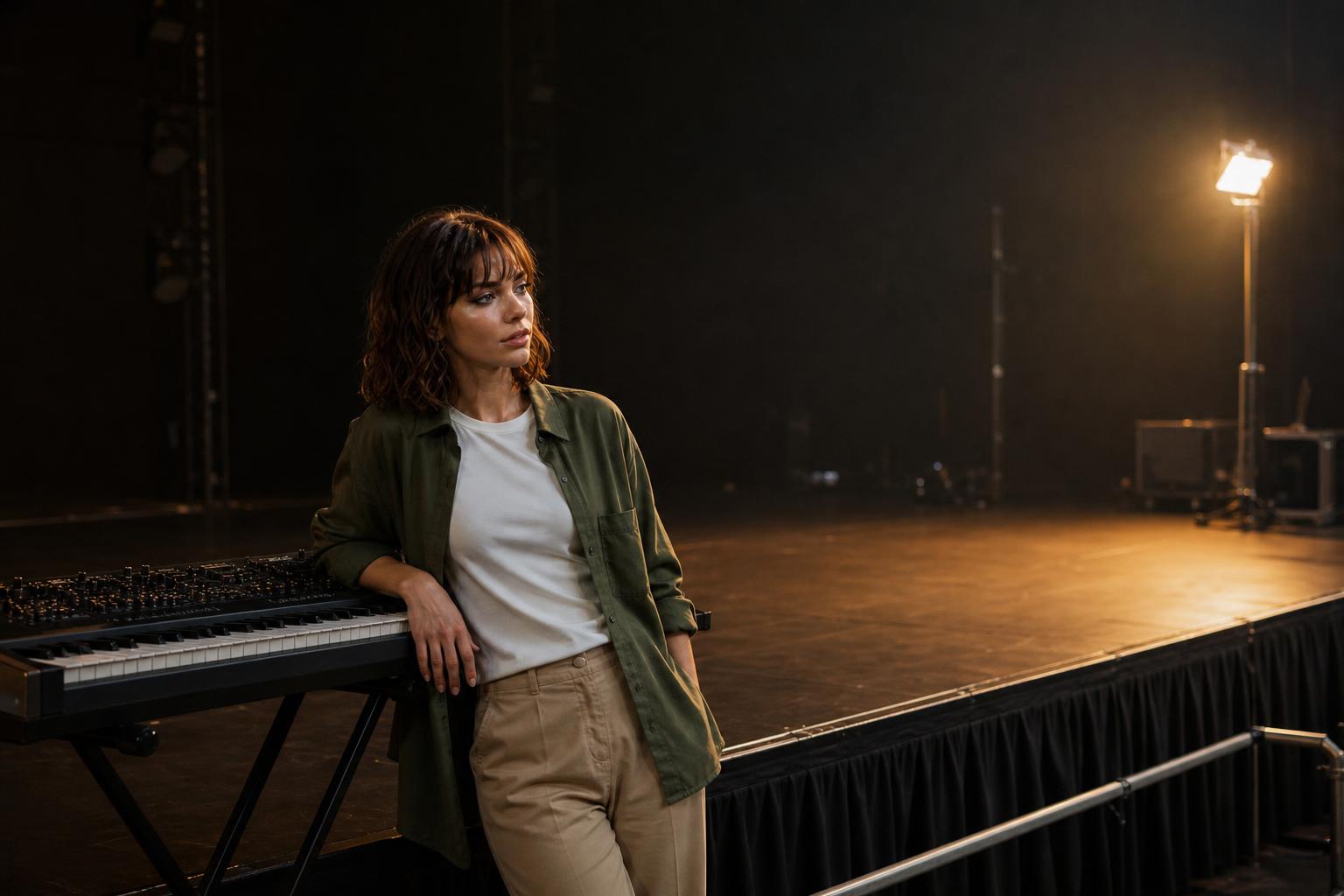
When she crosses to the stage later, the change is subtle but intentional. Now wearing an olive‑green overshirt over a white crew‑neck T‑shirt and beige trousers, Aira carries nothing but a cable loop and a quiet confidence. The stage is almost empty: one unused keyboard, a coiled cable, and a single warm work lamp that throws a small cone of amber light. The rest of the room holds its breath.
She settles at the keyboard the way someone sits into a familiar chair — not claiming it, merely acknowledging a partner. Her fingers hover over a few keys; she chooses not to flood with chords but to let a single tone speak and decay. A tiny problem comes up: the lamp’s bulb hesitates, flickering like a shy blink. Aira pauses, nudges the base, and checks the socket with the same practical calm she used on the speaker screw.
The lamp steady again, she lets the warmth fill just that little island of stage. Shadows lengthen but do not crowd; the keyboard answers with a clear, honest resonance. Aira plays a short motif — a line, unadorned, and then silence. The reverb in the empty hall holds it as if the room itself has learned the phrase and repeats it in slow motion. She listens, counting breaths, not beats.
Between two quiet phrases she counts out loud to herself, four measured breaths that are part metronome, part ritual. “Four and then if needed, we give it to them,” she says, smiling at an imagined audience that hasn’t arrived. She tucks a soft sub tone underneath the main note, so faint it’s almost a suggestion. The result is paradoxical: the smaller element becomes the measure of expectation.
Aira rises, palms resting flat on the keyboard as if feeling its heartbeat. She scans the empty seats and imagines mass without volume — a density made from held silence. The idea of a drop here is not a shock but a filling: the sound arrives and meets a prepared void, giving weight to restraint. In that balance AIRA-FLOW feels less like a project and more like a patient conversation between sound and absence.
She leaves the stage with the lamp still glowing and the keyboard breathing soft echoes. Outside the window the sun has shifted; inside, her notes and small repairs remain like footprints. Aira takes one last look at the solitary speaker, the lamp, the notebook with its two words, and closes the door gently, as if the most persuasive things are those you don’t announce loudly but allow to settle into a room’s shape.
← Back to the blog