
Aira walks the riverside at blue hour, camera at eye level, practical lighting and a deliberate refusal of familiar neon clichés — one small scene, two locations, a lot of night.
"Keep it quiet," Aira mutters as she steps off the path and onto the worn wooden prom, the coat collar pulled up against the cool river breath. Her cream crew-neck knit peeks from beneath the long coat; dark jeans brush the board edge. The lamp posts along the promenade are modest, producing narrow, believable bands of light that catch the green-teal of her eyes rather than wash everything in color.
She walks slowly, hands in pockets, the camera following at eye level — no swoops, no aerial distance. Aira takes out a small notebook, writes a sentence while the water murmurs beside her: "Avoid the club shorthand." Bicycles hum in the distance; a practical lantern throws a soft, warm oval on the path. The effect is domestic and honest, a cinematic language that trusts ordinary illumination.
A loose plank complains beneath her boots; the wood gives a sharp, private sound and Aira stops, cursing under her breath with a wry smile. She taps a corner of the notebook, sketching the way the lamppost shadow cuts across the board. "Too much edge, not enough midtones," she says aloud, half to herself, half to the invisible camera. The moment is small, but it forces a choice about how shadow can shape rhythm.
Near the riverbank, a pair of practical floodlights behind trees lend only enough fill to read facial detail — freckles warm under the light, the green-teal eyes readable without glam. Aira tests a gesture, tilting her head, letting a hand slide to the collar of her coat. The camera holds at shoulder level, allowing for skin texture and breath; it feels like watching someone breathe, not a constructed tableau.
She pockets the notebook and walks on, considering a low bridge whose pylons throw repeatable verticals. "Those columns could be beats," she says into a small recorder clipped to her coat. She imagines the river's darker stretches becoming rests between measures. The night is musical without a club rhythm; AIRA-FLOW’s vocabulary can be tempo through space instead of through saturated color.
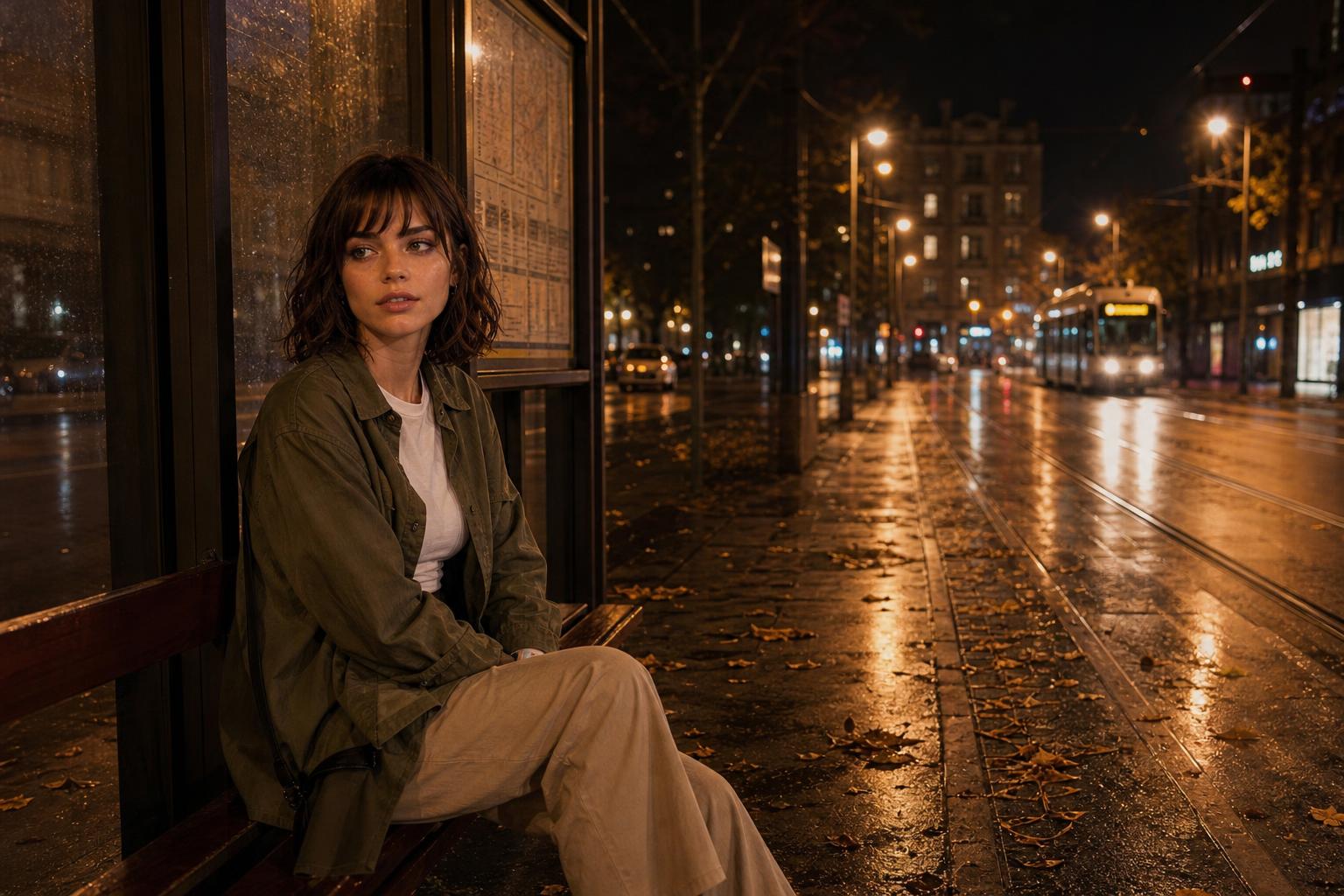
The scene shifts seamlessly to a city tram shelter under ordinary sodium light — warm, slightly orange, and utterly human. Aira has switched layers: an olive-green overshirt over a white crew-neck T and beige trousers; a lighter, everyday silhouette. She stands at eye level from the camera, the shelter casting a rectangular patch of light that reads as domestic stage lighting rather than spectacle.
An older woman with a folded newspaper shares the bench; she glances up and offers a brief smile. "Quiet night," she says. Aira replies with a dry half-grin, "Good for rehearsing mistakes." They exchange nothing weighty, only the kind of small social punctuation that keeps a city from feeling staged. Aira sits, crosses her legs, and tugs at a stray thread on her bag — a tiny prop test.
The tram is delayed; a soft inconvenience, not a crisis. Aira folds her arms, watches the warm glow pool on the wet asphalt, and improvises: she props her phone on the bench and studies how the light falls away, taking notes on reflection density and shadow gradients. It’s a small decision — where to let darkness stay dark — but it becomes decisive for the project's visual restraint and for AIRA-FLOW’s nighttime temperament.
She speaks quietly into her recorder: "Less saturation, more dialectic between warm and cool sources." The waiting breeds composition. The streetlamp draws a soft halo around her, freckles visible without makeup theatrics, the skin appearing honest and tactile. There is no glitter, no engineered sparkle; the emotion is conveyed through texture and space, not embellishment, and the images feel like true human moments rather than set pieces.
When the tram finally arrives, Aira stands, zips her coat, and offers the older woman a polite nod. There is no grand reveal, no flourish — only a calm transition, another page marked in the notebook. AIRA-FLOW’s nocturnal language remains intimate and practical: scenes lit by everyday sources, choices made by attention, and a quiet conviction that cinematic depth can grow from ordinary light.
← Back to the blog