
A brief vignette from the AIRA-FLOW atelier: Aira experiments with arrangement choices to keep a three-minute track lively. Not a lecture, but a quiet practical moment of work — patient, textured, and decisively unspectacular.
“Again, one bar and listen.” Aira’s fingers trace a soft curve on the sequencer as the attic light tilts across the keyboard. She’s in a navy long-sleeved shirt and charcoal trousers; the room smells faintly of old paper and warm plastic. The LED markers are modest, the action is not showy. She nudges a tiny envelope, watches a synth pad breathe differently, and hums a line under her breath.
She stops the transport and leans forward, chin nearly touching the keys, muttering: “Don’t let it stall.” The middle of the track sits like a shallow pool, and she taps a tempo with her index finger on the wood of the desk. AIRA-FLOW’s atmospheric presence hangs in the air — not a logo, but a mood — as she chooses texture over louder hits to coax movement without adding clutter.
A small problem emerges: the bass stays too steady, a comfortable constant that flattens the arc. Aira pulls a short automation lane and trims the sub by two decibels for two bars, then eases it back up. It’s a micro-gesture, almost invisible, yet it nudges the listener forward. She smiles, amused at her own vocabulary of tiny evasions, and whispers to the blank monitor, “Wander, don’t plummet.”
She experiments with percussive micro-events generated from the same pad sound, carving a pluck that sits between the offbeats. No new instruments, just a different contour from existing material: a shorter decay, a quicker attack, a breath of amplitude modulation. The change is surgical; it leaves the main rhythm intact but insists on attention. Aira writes a small note: “stutter = forward.” It’s practical, not dogmatic.
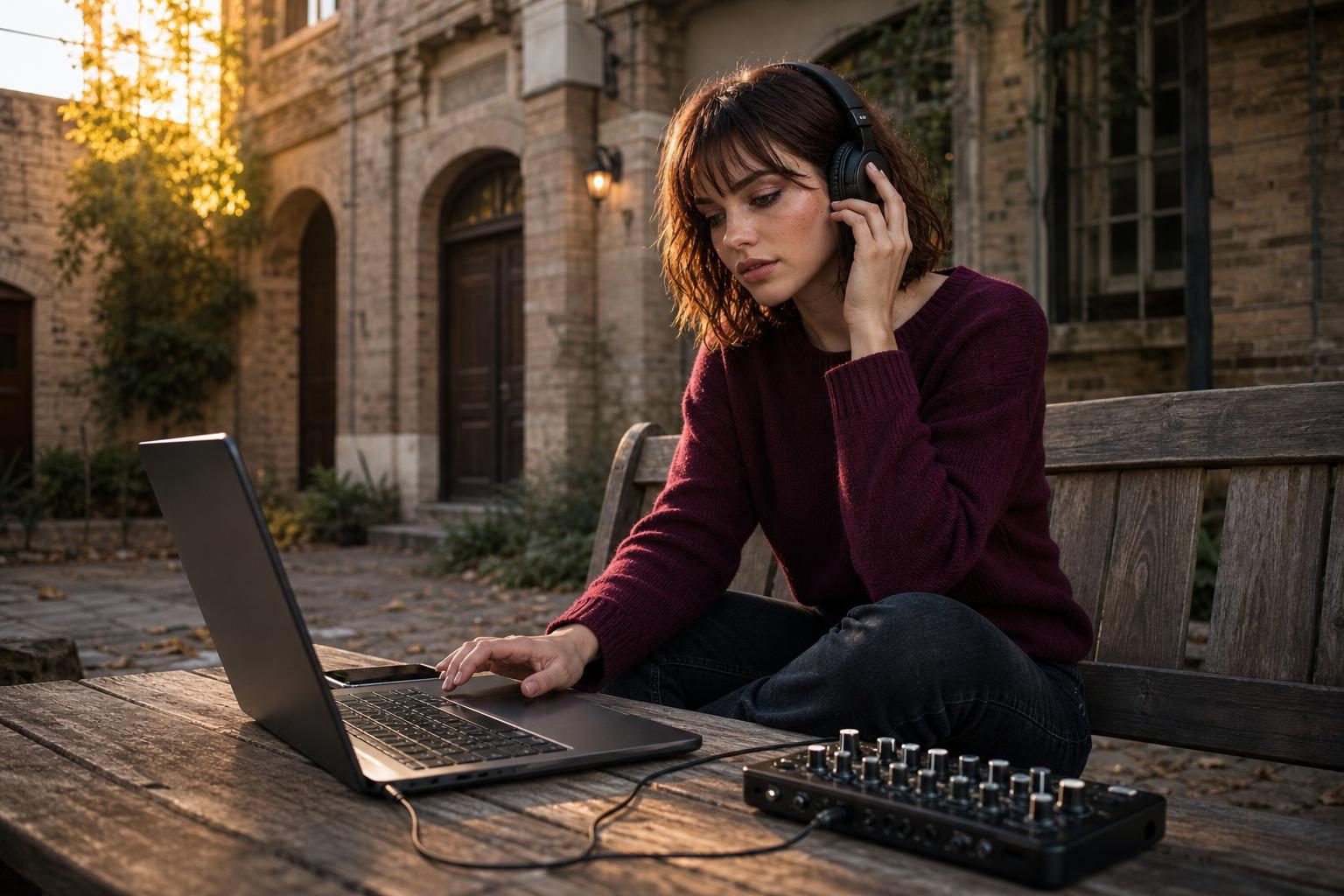
The camera — if anyone were filming — stays at eye-level, steady and honest, catching the freckles near her nose as she glances up. Aira lifts the headphones, listens without them, then turns them back on and tilts her head, listening for the space that will carry sound through the middle. She chooses a secondary motif that appears only when primary elements fold back, a conversational reply rather than a new statement.
Later, in a courtyard at late afternoon, she sits on a bench wearing a burgundy crew-neck sweater and dark jeans, headphones resting at her throat. Natural light pools across the stone. She runs a mix at half volume, letting the street’s distant rhythm fall into the track’s gaps. Aira watches a shadow move across her knee and adjusts a midrange pad to make room instead of filling it — a decision born of listening in context rather than theory.
A small dog pads by, and she grins, jotting a note on a cheap index card: “give the ear a rest.” The revised middle relies on negative space and intermittent accents — syncopated phrasings that peek through instead of an extended solo. In the courtyard’s hush, those accents sound like breaths; they’re intimate, almost conspiratorial, and the track regains a forward momentum that feels earned rather than manufactured.
Back in the attic, Aira replays the updated section and notices how a recurring two-bar figure changes depending on its velocity and filtering. She programs slight variations so the figure never lands identical twice, a tiny voice that insists on continuing the story. The modest automation curves and staggered delay throws make the middle feel like a moving corridor rather than a room where the lights dim.
She murmurs pragmatic rules aloud — “micro-contrast, leave space, repeat but alter” — and treats them like experiments, not absolutes. The AIRA-FLOW approach here is empirical: try small, listen, change. Each adjustment is economical; instead of layering more sounds, she reshapes what’s already present so the three-minute timeline reads as a sequence of purposeful micro-decisions that keep interest alive without over-explaining.
When the session winds down, there’s no bombastic finale, only a tidy fade that lets the listener sit with the change. Aira folds the index cards, glances out the attic window as late light thins, and smiles at the quiet of the room. The middle of the track has regained motion through restraint and precise tiny moves; she packs up, knowing the piece breathes again without needing to shout. AIRA-FLOW remains a practice of subtle craft.
← Back to the blog